array(23) {
["date"]=>
string(10) "2026-02-24"
["headline"]=>
string(96) "Finding Signal in the Noise: Lessons Learned Running a Honeypot with AI Assistance [Guest Diary]"
["updated"]=>
string(19) "2026-02-26 12:21:37"
["text"]=>
string(10209) "
[This is a Guest Diary by Austin Bodolay, an ISC intern as part of the SANS.edu BACS program]
Over the past several months, I have gained practical insight into the challenges of deploying and operating a honeypot, even within a relatively simple environment. This work highlighted how varying hardware, software, and network design—can significantly alter outcomes. Through this process, I observed both the value and the limitations of log collection. Comprehensive telemetry proved essential for understanding activity targeting the honeypot, yet it also became clear that improperly scoped or poorly interpreted logs can produce misleading conclusions. Prior to this research, I had almost no interaction with AI tools and struggled to identify practical ways to integrate them into my work. Throughout this experience, however, AI proved most valuable not as an automated solution, but as a collaborative aid—providing quick syntax on the CLI, offering alternative perspectives, and helping maintain analytical focus.
Introduction
The DShield honeypot is a sensor that pretends to be a vulnerable system exposed to the internet. It collects information from scans and attacks that are often automated, providing insight to analyst what threat actors are targeting and how. The honeypot generates a large amount of data, much of it low-value. Deciding what is meaningful, what separate events are related, and what (if any) actions should be taken. Being able to accurately assess the data requires the right information. And in the event a true incident does occur, being able to piece together the breadcrumbs requires the data is actually there. Piecing it all together requires the right methodology. Using an AI, like ChatGPT, is extremely helpful in tying these concepts together.
The Data: What Was Collected and Why
In the few months my SIEM has collected 8 million logs from 14,000 unique IP addresses. There is a lot of noise on the internet from automated scanners and toolkits that frequently repeat the same actions to every device willing to listen. This constant "background noise" on the internet are systems constantly scanning for what is available, what is potentially vulnerable, and what is low hanging fruit that can provide a foothold for something more. Is there an exposed administrative panel? Do these default credentials work anywhere? And if so, what does information does this hold or what does it have access to? Is this a developer? Does the system have private information worth value? The honeypot sensor provides a way to analyze this traffic to better understand what threat actors are after and how they are going after it.
The basic information that is collected on the honeypot includes source IP addresses, port, protocol, URL, and a few other metrics. The logs primarily record the traffic that was sent to the honeypot. If your router dropped the packets or failed to send them to the honeypot, the logs will not be generated to be sent to the SIEM. The NetFlow logs add a little extra information, like the direction of the packets, the byte count, and packets that were dropped before reaching the honeypot. What my current system does not show is the actual payloads in the traffic, the headers of packets, or the exploit details. ChatGPT helped identify what type of data I actually have, what types of conclusions can be drawn from this data, and methods to validate these conclusions. ChatGPT also identified dead ends early on, saving me time from going down rabbit holes by pointing out the current data will never be able to positively affirm any conclusion.
Part One:
I came across a log that raised some concerns. After providing simple details of the devices involved, the type of log generated, clarifying the log is on the gateway and not the SIEM, and the values recorded in the data, ChatGPT provided insights as to what likely generated this traffic and why it likely isn't an alternative event. I performed additional research to confirm this information is true.
Interaction with ChatGPT
Part Two:
Researching a unique User-Agent "libredtail-http", I began checking a high level how frequently this shows up. I noticed that in several months of logs, this User-Agent appeared for the first time on my sensor in December of 2025. There are 34 unique IP addresses that have used it, most of which have less than 100 events. Interestingly, all events occur on the same days, with up to 2 weeks of silence between the next set of events. Additionally, the URL request and payload sizes were identical among all events, regardless of the source IP address. When researching the User-Agent string "libredtail-http", I came across many articles about malware. Sharing some of the information found with ChatGPT, it quickly identified what I was likely seeing, who it is targeting, what makes an event vulnerable to the attacks, and how to protect from them. More likely than malware, what I was seeing is an automated multi-staged toolkit that is scanning the internet for vulnerable Apache servers, Linux web interfaces, and IoT devices. The source of scans is using low-cost methods to rotate through IP addresses, combined with intermittent campaign timing (burst -> idle -> burst) to reduce detection and attribution. This is likely a botnet and the goal is to enroll new systems into the botnet for additional scanners, proxies, and DDoS nodes. I then began researching this information, such as the CVE mentioned by ChatGPT, indicators of compromise (IOCs), and comparing various sources to what I have in my logs to validate the accuracy of the statements. The responses were very accurate. Had I not used ChatGPT, I would have started searching for IOCs in my logs for signs of malware mentioned in the articles and possibly wasted several hours. I likely would have come to a similar conclusion, but I admit it would have used a lot of my time.
Interaction with ChatGPT based on findings above.
I have found the most value comes by clearly stating what your objective is. The more details provided early on reduce vague answers.
Conclusion and Lessons Learned
Having more logs doesn't equal more answers. If a system is comprised and reaches out to a malicious server, having logs of only incoming traffic won't ever catch this malicious activity. And if you have logs showing a connection with a large volume of data outgoing, but the logs don't include the actual content in the packets, it's nearly impossible to know what was actually inside those packets. And if you are tasked with reviewing tens of thousands or millions of logs, it’s nice to have some help. Consider the use of central logging, something like a SIEM, combined with reaching out to a team member for some help if you are part of a team.
The structural integrity of modern society is predicated upon a dense and often opaque network of interconnected systems. For decades, the modeling of these systems remained siloed within specific domains: industrial processes were governed by the hierarchical constraints of the Purdue Model, while corporate and data-centric ecosystems were organized using various Enterprise Architecture (EA) frameworks (Fortinet, n.d.; The Open Group, n.d.). However, the accelerating convergence of Information Technology (IT) and Operational Technology (OT) has exposed a critical analytical gap. Disruptions in the external utility grid, once considered an unlikely factor, now propagate through the physical and logical layers of the enterprise with devastating speed, as evidenced by recent power-related disconnections of large-scale data center operations (Mural et al., 2026; Islam et al., 2023).
To bridge this gap, this report introduces the Comprehensive Linkage and Architectural Infrastructure Resiliency (CLAIR) Model. The CLAIR Model is a new conceptual framework that synthesizes the vertical depth of the Purdue Enterprise Reference Architecture (PERA) with the multi-dimensional, interrogative breadth of the Zachman Framework for Enterprise Architecture (Fortinet, n.d.; The Open Group, n.d.). By establishing a unified taxonomy that accounts for everything from the sub-physical utility grid to the hyper-distributed cloud, the CLAIR Model provides a structured scope for identifying and visualizing critical infrastructure interdependencies. This framework prioritizes the identification of these linkages over specific mitigations, offering a diagnostic tool for understanding how failures in one sector, such as the power grid, generate cascading effects across the data center and manufacturing landscapes (Fortinet, n.d.; Islam et al., 2023; Virginia Department of Emergency Management, n.d.).
Historical Context and the Necessity of Synthesis
The conceptual origin of industrial modeling lies in the 1990s at Purdue University, where researchers developed the Purdue Enterprise Reference Architecture (PERA) to standardize computer-integrated manufacturing (Fortinet, n.d.). The Purdue Model established a functional hierarchy ranging from Level 0 (physical processes) to Level 4 (business logistics), effectively creating an "automation pyramid." Isolation of sensitive controllers from internet-facing business networks is typically achieved via a "demilitarized zone" (DMZ) at Level 3.5 (Fortinet, n.d.).
While the Purdue Model excels at describing the internal dependencies of a single plant, it is inherently insular. It treats the external world as a series of inputs (Level 0) or external services (Level 5) without mapping the complex, bidirectional relationships between the plant and the broader infrastructure (Cybersecurity and Infrastructure Security Agency, 2025a; Williams, 1994). In parallel, Enterprise Architecture (EA) frameworks like Zachman were developed to organize the design artifacts of complex organizations from multiple stakeholder perspectives (The Open Group, n.d.). The CLAIR Model recognizes that neither framework, in isolation, can characterize the risks of a "system-of-systems" environment (Department of Defense, 2008). In modern critical infrastructure, a data center is not merely a facility at Level 4 of the Purdue Model; it is a massive electric load at the intersection of global telecommunications, regional power grids, and local water supply systems (UK Parliament, 2025; Chen et al., 2025). Failure to understand these dynamics results in ineffective response and poor coordination between decision-makers (Dudenhoeffer et al., 2006).
The CLAIR Model: Structural Hierarchy and Extended Levels
The CLAIR Model expands the traditional five-level Purdue hierarchy into a ten-level architectural stack. This expansion is designed to capture the "Level -1" dependencies on primary utility infrastructure and the "Level 6" and "Level 7" dependencies on cloud and safety systems (CISA, 2025a; Russo, 2022).
CLAIR MODEL: 10-Level Architectural Stack
Level
Layer
Description
Typical assets
>7
High-Trust / Safety Systems
Ultimate integrity & safe-state maintenance
SIS, DNSSEC, Digital root of trust
6
The Connected World
External cloud & distributed services
AWS/Azure, IIoT platforms,external VPNs
5
Corporate Enterprise
Business planning & enterprise services
ERP, HR portals, BI/analytics
4
Business Operations
Resource Management & Workflow Execution
Workflow tools, Data Repositories, Reporting
3.5
Operational Boundary / Industrial DMZ
IT-OT convergence, traffic filtration, System Integration &Traffic Management
Power grid, Water, Pipelines, Network Backbones, Core Communication
Level -1: The Primary Infrastructure Foundation
The inclusion of Level -1 acknowledges that the "physics" of Level 0 is entirely dependent on a primary technology layer that exists outside the control of the plant operator (Islam et al., 2023). In the CLAIR Model, Level -1 encompasses the electricity generation and transmission systems, which exhibit complex dynamic behaviors such as low inertia and harmonic distortion when interfacing with data center power electronics (Chen et al., 2025). This layer is the source of cascading failure triggers, where a line fault in the high-voltage grid necessitates immediate load redistribution, often leading to voltage fluctuations that destabilize Level 0 sensors and Level 1 controllers (Islam et al., 2023).
Levels 0-5: What Can Be Controlled
Levels 0–5 are generally within the organization’s direct control because the systems, assets, and processes at these layers are typically owned and/or administered by the business, company, or government entity. However, even within this “control zone,” organizations still inherit external dependencies, especially for software, firmware, and operating systems that rely on vendor-provided patches and updates. If an update is delayed, unavailable, or operationally difficult to deploy, the organization may remain exposed to known vulnerabilities or be forced to rely on temporary mitigations until a corrective patch can be implemented (Souppaya & Scarfone, 2022). As a result, these layers may appear internally controlled while quietly depending on upstream providers and external services that introduce risk across otherwise well-managed environments.
Level 6 and 7: The Distributed Sovereignty
As organizations move toward "Smart Factories" and "Hyperscale Data Centers," the reliance on Level 6 (The Connected World) becomes absolute (CISA, 2025a). This level includes the Cloud-Fog-Edge computing model, where instant processing occurs at the edge but long-term analytics and orchestration reside in the cloud (CISA, 2025a). Level 7 represents the "Safety and High-Trust" layer, which is isolated even from the corporate enterprise to ensure that catastrophic failures at lower levels do not prevent a safe system shutdown (Russo, 2022). Level 7 are systems or items that are critical to restoration of levels 0-6 within the organization. The loss of level 7 is a catastrophic issue.
Integrating Enterprise Architecture: The CLAIR MatrixLinkeIn)
The CLAIR Model maps its ten levels against the six interrogatives of the Zachman Framework to identify dependencies across different dimensions of the infrastructure (The Open Group, n.d.).
The What (Data and Resource Flow): At the lower levels (-1 to 1), "data" is often a physical resource flow, such as electrons or water pressure (VA DEM, n.d.). At the higher levels (4 to 6), it transitions into digital information payloads (Macaulay, 2025)
The How (Operational Function): This dimension describes the transformation processes, from ladder logic at Level 1 to machine learning algorithms at Level 6 (CISA, 2025a; Australian Signals Directorate, 2024).
The Where (Network and Spatial Distribution): This captures geographic interdependencies (Dudenhoeffer et al., 2006). A physical collapse of a pylon destroys both the power source (Level -1) and the communication path (Level 3) sharing that pylon (Islam et al., 2023; VA DEM, n.d.).
The Who (Stakeholder and Actor Matrix): Maps "managerial independencies" where a Distribution System Operator (DSO) at Level -1 must coordinate with a corporate CIO at Level 5 and a third-party cloud provider at Level 6 (DoD, 2008; Islam et al., 2023).
The When (Temporal Dynamics): Visualizes the "transient response" during a failure, showing how a grid frequency deviation at Level -1 propagates through the stack faster than a Level 2 supervisory system can respond (Islam et al., 2023; Shuvro et al., 2023).
The Why (Motivation and Strategy): Identifies where business goals conflict, such as a utility shedding load to save the grid versus a data center's 99.999% availability goal (Mural et al., 2026; The Open Group, n.d.).
Case Study: Power Grid Failures and Data Center Operations
The CLAIR Model demonstrates that power grid failures are not merely physical events; they are systemic crises. Data centers are emerging as prominent large electric loads with demand patterns characterized by high power density (Mural et al., 2026; Chen et al., 2025).
The Mechanism of Cascading Failure
A cascading failure is a sequence where one component malfunction triggers successive failures in a "domino mechanism" (Islam et al., 2023). Within the CLAIR framework:
The Trigger (Level -1): A disturbance, such as a transmission line failure, occurs in the utility grid (Shuvro et al., 2023).
Load Redistribution: The grid redistributes flow, but because data centers have massive, steady loads, this can push remaining infrastructure beyond capacity (Mural et al., 2026; Islam et al., 2023).
Voltage Fluctuations: A sudden fluctuation in Northern Virginia recently triggered the simultaneous disconnection of 60 data centers, creating a 1,500-megawatt (MW) power surplus almost instantly (Mural et al., 2026).
Information Blindness: As power fails, the cyber network monitoring the grid may also fail. If cloud-based analytics (Level 6) lose connectivity, operators lose visibility, leading to erroneous adjustments and a total blackout (Islam et al., 2023; CISA, 2025a).
Identifying Dependencies: A Typological Deep-Dive
The CLAIR Model categorizes every identified link into a matrix of dependency types. This taxonomy is essential for understanding the nature of the vulnerability.
Dependency Type
Nature of the Link
Impact Mechanism
Example in CLAIR
Physical
Material transfer
Functional failure due to lack of inputs
Level -1 power supplying Level 0 servers
Cyber
Information transfer
Loss of control or visibility
Level 6 cloud service providing ML insights to Level 1
Geographic
Shared location
Common-cause failure (e.g., flood)
Power and fiber sharing a common utility trench
Logical
Policy/Regulation
Change in operational state due to external mandate
Utility load-shedding during a heatwave
Sankey Flow Maps for Dependency Visualization
To visualize inbound and outbound data dependencies, organizations can use Sankey Flow Maps; flow diagrams that represent transfers or reliance relationships using variable-width links, where wider flows indicate greater magnitude or criticality (Schmidt, 2008). Rather than ranking sensitivities as standalone bars, this method makes dependency direction and coupling immediately visible by placing the system-of-interest at the center and showing weighted flows entering and exiting it.
Inbound dependencies (inputs to the system): The external data, services, or control-plane functions that the system relies on to operate (e.g., identity assertions, routing/DNS, upstream connectivity, threat intelligence feeds).
Outbound dependencies (outputs from the system): The downstream systems, users, or business processes that rely on the system’s outputs (e.g., hosted applications/APIs, telemetry to security monitoring, billing/FinOps data).
???????
In practice, each flow can be assigned a dependency “weight” (e.g., criticality, volume, recovery difficulty, or a composite score), enabling teams to quickly identify high-consequence dependencies and prioritize resilience, monitoring, redundancy, and governance controls.
AI as an Interdependency Vector in the CLAIR Model
The integration of AI across levels creates new interdependencies. AI models at the operational layers (0-3) introduce risks such as data quality dependency, model drift, and an explainability gap (ASD, 2024). To maintain resilience, the CLAIR Model incorporates operational constraints like the "80% bandwidth rule," ensuring that data aggregation for AI training does not exceed network capacity to protect critical control signals at Level 1 (ASD, 2024).
AI-OT Convergence Risks
When AI models are deployed at the operational layers (0-3), they introduce failure mechanisms not present in traditional deterministic system:
Data Quality Dependency: AI models at Level 1 depend on the normalization and quality of sensor data from Level 0. If the sensors are compromised (even at the physics level), the AI will make decisions based on untrusted data.
Model Drift Dependency: Over time, alterations to production processes can cause an AI model to drift from its initial training. This creates a temporal dependency where the model must be periodically updated from Level 6, creating a cyber-linkage that bypasses the DMZ.
Explainability Gap: In a crisis, if an AI-driven controller at Level 1 fails or takes an unexpected action, the "Lack of Explainability" increases the operator's recovery time, potentially allowing a local failure to cascade into a regional one.
National Security and Policy Frameworks: The Institutional Why
The "Why" of the CLAIR Model is increasingly driven by policy, such as the National Security Memorandum on Critical Infrastructure Security and Resilience (NSM-22) (Congressional Research Service, 2024). This framework groups infrastructure functions into four areas: connect, distribute, manage, and supply, which the CLAIR Model maps to specific assets and their dependencies across the stack (CRS, 2024; CISA, 2025b).Maturity and Assessment in the CLAIR Framework
To evaluate the strength of identified dependencies, the CLAIR Model adopts maturity indicator levels (International Atomic Energy Agency [IAEA], 2021).
Impact on Dependency Risk Real-time visualization across the entire stack
Maturity Level
Characteristic in CLAIR
MIL 0
No implementation
Opaque dependencies; unpredictable failure
MIL 1
Ad hoc / Informal
Some visibility; no standardized monitoring
MIL 2
Consistent / Monitored
Mapped dependencies; defined failure thresholds
MIL 3
Fully Integrated
A key insight is that resilience is only as strong as its weakest link. If a data center has MIL 3 resilience at Level 5 but relies on a Level -1 power source with MIL 0 monitoring, the overall system resilience is effectively MIL 0 (IAEA, 2021).
Conclusion: Visualizing the Interconnected World
The CLAIR Model synthesis of the Purdue Model and Enterprise Architecture moves beyond a narrow view of internal security toward a holistic understanding of infrastructure interdependencies (CISA, 2025a). It demonstrates that the impact of a power grid failure on data centers is multi-dimensional, involving transients at Level -1, sensor failure at Level 0, and business discontinuity at Level 4 (Mural et al., 2026; Islam et al., 2023). By focusing on these linkages, from the physics of the grid to the logic of the cloud, architects can finally visualize the "walking failures" that define our interconnected world (Islam et al., 2023; CISA, 2025b).
References
Australian Signals Directorate. (2024). Principles for the secure integration of artificial intelligence in operational technology. Cyber.gov.au. Accessed January 26, 2026.
Chen, X., Wang, X., Colacelli, A., Lee, M., & Xie, L. (2025). Electricity demand and grid impacts of AI data centers: Challenges and prospects. Accessed January 22, 2026.
Congressional Research Service. (2024). National security memorandum on critical infrastructure security and resilience (NSM-22). Accessed January 28, 2026.
Cybersecurity and Infrastructure Security Agency. (2025a). Infrastructure resilience planning framework (IRPF) primer. Accessed January 18, 2026.
Cybersecurity and Infrastructure Security Agency. (2025b). Infrastructure resilience planning framework (IRPF) v3.17.2025. Accessed January 30, 2026.
Department of Defense. (2008). Systems engineering guide for systems of systems (Version 1.0). Accessed January 20, 2026. Dudenhoeffer, D. D., Permann, M. R., & Manic, M. (2006).
CIMS: A framework for infrastructure interdependency modeling and analysis. Winter Simulation Conference. Accessed January 23, 2026. Fortinet. (n.d.).
What is the Purdue model for ICS security?. Fortinet.com. Accessed January 13, 2026. International Atomic Energy Agency [IAEA]. (2021).
Maturity-model-paper-ICONS. Accessed January 30, 2026. Islam, M. Z., Lin, Y., Vokkarane, V. M., & Venkataramanan, V. (2023).
Cyber-physical cascading failure and resilience of power grid: A comprehensive review. Frontiers in Energy Research. Accessed January 16, 2026. Macaulay, T. (2025).
The danger of critical infrastructure interdependency. CIGI Online. Accessed January 25, 2026.
Mural, R., Pherwani, D., Gupta, C., Yu, Y., Takahashi, A., Kim, D., Majumder, S., Lee, H., Yu, M., & Xie, L. (2026).
AI, data centers, and the U.S. electric grid: A watershed moment. Belfer Center for Science and International Affairs. Accessed January 15, 2026.
Natural Hazards Review. (2021). Overview of interdependency models of critical infrastructure for resilience assessment (Vol. 23, No. 1). Accessed January 29, 2026.
Russo, S. (2022). Industrial DMZ and zero trust models for ICS. AMS Laurea. Accessed 10 January 24, 2026.
Shuvro, R. A., Das, P., Jyoti, J. S., Abreu, J. M., & Hayat, M. M. (2023). Data-integrity aware stochastic model for cascading failures in power grids. Marquette University. Accessed January 27, 2026.
The Open Group. (n.d.). Mapping the TOGAF ADM to the Zachman framework. Opengroup.org. Accessed January 14, 2026. UK Parliament. (2025).
Data centres: Planning policy, sustainability, and resilience. Accessed January 21, 2026.
Virginia Department of Emergency Management. (n.d.). Understanding critical infrastructure dependencies and interdependencies. Accessed January 17, 2026. Williams, T. J. (1994).
The Purdue enterprise reference architecture (PERA). Industry-Purdue University Consortium. Accessed January 19, 2026. Schmidt, M. (2008).
The Sankey diagram in energy and material flow management, Part I: History. Journal of Industrial Ecology, 12(1), 82–94. https://doi.org/10.1111/j.1530-9290.2008.00004.x Accessed: February 11, 2026
Souppaya, M., & Scarfone, K. (2022). Guide to enterprise patch management planning: Preventive maintenance for technology (NIST Special Publication 800-40 Rev. 4). National Institute of Standards and Technology. Retrieved January 24, 2026, from https://doi.org/10.6028/NIST.SP.800-40r4
"
["live"]=>
string(1) "Y"
["serial"]=>
int(0)
["id"]=>
int(642063)
["storyid"]=>
int(32748)
["version"]=>
int(1)
["madelive"]=>
string(19) "2026-02-26 12:21:26"
["frontpage"]=>
string(1) "Y"
["rank"]=>
int(5)
["type"]=>
string(7) "handler"
["digg"]=>
string(0) ""
["ratesum"]=>
int(0)
["ratecount"]=>
int(0)
["hits"]=>
int(0)
["locked"]=>
int(0)
["lastreply"]=>
string(19) "0000-00-00 00:00:00"
["tweet"]=>
string(100) "The CLAIR Model: A Synthesized Conceptual Framework for Mapping Critical Infrastructure Interdepende"
["votes"]=>
int(0)
["tweeted"]=>
string(1) "Y"
["byline"]=>
string(12) "Claire Perry"
}
array(23) {
["date"]=>
string(10) "2011-08-17"
["headline"]=>
string(68) "When Good Patches go Bad - a DNS tale that didn't start out that way"
["updated"]=>
string(19) "2011-08-18 03:32:16"
["text"]=>
string(26041) "
I recently had a client call me, the issue that day was "the VPN is down". What it turned out to be was that RADIUS would not start, because some other application had port UDP/1645 (one of the common RADIUS ports) open. Since he didn't have RADIUS, no VPN connections could authenticate.
So, standard drill, we ran "netstat -naob", to list out which application was using which port, and found that DNS was using that port. Wait, What, DNS? DNS doesn't use that port, does it? When asked, what port does DNS use, what you'll most often hear is "UDP/53", or more correctly, "TCP/53 and UDP/53", but that is only half the story. When a DNS server makes a request (in recursive lookups for example), it opens an ephemeral port, some port above 1024 as the source, with UDP/53 or TCP/53 as it's destination.
So, ok, that all makes sense, but what was DNS doing, opening that port when the service starts during the server boot-up sequence? The answer to that is, Microsoft saw the act of opening the outbound ports as a performance issue that they should fix. Starting with DNS Server service security update 953230 (MS08-037), DNS now reserves 2500 random UDP ports for outbound communication
What, you say? Random, as in picked randomly, before other services start, without regard for what else is installed on the server Yup. But surely they reserve the UDP ports commonly seen by other apps, or at least UDP ports used by native Microsoft Windows Server services? Nope. The only port that is reserved by default is UDP/3343 - ms-cluster-net - which is as the name implies, used by communications between MS Cluster members.
So, what to do? Luckily, there's a way to reserve the ports used by other applications, so that DNS won't snap them up before other services start. First, go to the DNS server in question, make sure that everything is running, and get the task number that DNS.EXE is currently using:
You may want to edit this list, some of them might be ephemeral ports. If there's any question about what task is using which port, you can hunt them down by running:
taskilst | find "tasknumber"
or, run "netstat -naob" - - i find this a bit less useful since the task information is spread across multiple lines.
Finally, with a list of ports we want to reserve, we go to the registry with REGEDT32, to HKEY_LOCAL_MACHINESYSTEMCurrentControlSetServicesTcpipParametersReservedPorts
Update the value for this entry with the UDP ports that you've decided to reserve:
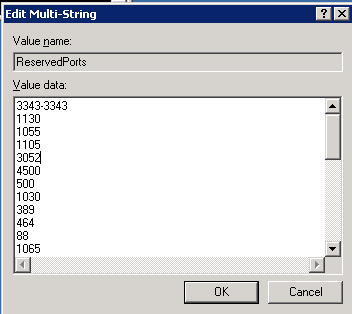
Finally, back to the original issue, RADIUS now starts and my client's VPN is running. We also added a second RADIUS back in - - the second RADIUS server had been built when the VPN went in, but had since mysteriously disappeared. But that's a whole 'nother story ...
If you've had a patch (recent or way back in the day) "go bad on you", we'd like to hear about it, please use our comment form. Patches with silly design decisions, patches that crashed your server or workstation, patches that were later pulled or re-issued, they're all good stories - - after they're fixed that is !
A final note:
Opening outbound ports in advance is indeed a good way to get a performance boost on DNS, if you have, say 30,000 active users hitting 2 or 3 servers. But since most organizations don't have that user count, a more practical approach to reserving ports would be to simply wait for queries, and not release the outbound ports as outbound requests leave the server, until the count is at the desired number. Maybe reserving ports should wait until the server has been up for some period of time, say 20 minutes, to give all the other system services a chance to start and get their required resources. Another really good thing to do would be to make the port reservation activity an OPTION in the DNS admin GUI, not the DEFAULT.
In Server 2008, the ephemeral port range for reservations is 49152-65535, so the impact of this issue is much less. You can duplicate this behaviour in Server 2003 by adjusting the MaxUserPort registry entry (see the MS documents below for details on this)
I recently had a client call me, the issue that day was "the VPN is down". What it turned out to be was that RADIUS would not start, because some other application had port UDP/1645 (one of the common RADIUS ports) open. Since he didn't have RADIUS, no VPN connections could authenticate.
So, standard drill, we ran "netstat -naob", to list out which application was using which port, and found that DNS was using that port. Wait, What, DNS? DNS doesn't use that port, does it? When asked, what port does DNS use, what you'll most often hear is "UDP/53", or more correctly, "TCP/53 and UDP/53", but that is only half the story. When a DNS server makes a request (in recursive lookups for example), it opens an ephemeral port, some port above 1024 as the source, with UDP/53 or TCP/53 as it's destination.
So, ok, that all makes sense, but what was DNS doing, opening that port when the service starts during the server boot-up sequence? The answer to that is, Microsoft saw the act of opening the outbound ports as a performance issue that they should fix. Starting with DNS Server service security update 953230 (MS08-037), DNS now reserves 2500 random UDP ports for outbound communication
What, you say? Random, as in picked randomly, before other services start, without regard for what else is installed on the server Yup. But surely they reserve the UDP ports commonly seen by other apps, or at least UDP ports used by native Microsoft Windows Server services? Nope. The only port that is reserved by default is UDP/3343 - ms-cluster-net - which is as the name implies, used by communications between MS Cluster members.
So, what to do? Luckily, there's a way to reserve the ports used by other applications, so that DNS won't snap them up before other services start. First, go to the DNS server in question, make sure that everything is running, and get the task number that DNS.EXE is currently using:
You may want to edit this list, some of them might be ephemeral ports. If there's any question about what task is using which port, you can hunt them down by running:
taskilst | find "tasknumber"
or, run "netstat -naob" - - i find this a bit less useful since the task information is spread across multiple lines.
Finally, with a list of ports we want to reserve, we go to the registry with REGEDT32, to HKEY_LOCAL_MACHINESYSTEMCurrentControlSetServicesTcpipParametersReservedPorts
Update the value for this entry with the UDP ports that you've decided to reserve:
Finally, back to the original issue, RADIUS now starts and my client's VPN is running. We also added a second RADIUS back in - - the second RADIUS server had been built when the VPN went in, but had since mysteriously disappeared. But that's a whole 'nother story ...
If you've had a patch (recent or way back in the day) "go bad on you", we'd like to hear about it, please use our comment form. Patches with silly design decisions, patches that crashed your server or workstation, patches that were later pulled or re-issued, they're all good stories - - after they're fixed that is !
A final note:
Opening outbound ports in advance is indeed a good way to get a performance boost on DNS, if you have, say 30,000 active users hitting 2 or 3 servers. But since most organizations don't have that user count, a more practical approach to reserving ports would be to simply wait for queries, and not release the outbound ports as outbound requests leave the server, until the count is at the desired number. Maybe reserving ports should wait until the server has been up for some period of time, say 20 minutes, to give all the other system services a chance to start and get their required resources. Another really good thing to do would be to make the port reservation activity an OPTION in the DNS admin GUI, not the DEFAULT.
In Server 2008, the ephemeral port range for reservations is 49152-65535, so the impact of this issue is much less. You can duplicate this behaviour in Server 2003 by adjusting the MaxUserPort registry entry (see the MS documents below for details on this)
I've seen a few other cases where a random port allocator grabbed a port needed by a service. For TCP, it's usually an outbound connection, and modifying the code to pass SO_REUSEADDR (and possibly SO_REUSEPORT depending on OS) happens to fix the problem.
Bryan - I believe that you are correct. I've seen MS attribute this to both performance and security, but i think the real reason is as you state.
From a design perspective though, there's no reason that they couldn't randomize the port selection (and test port availability) at the time of the query though. If reservations are still a requirement, they could even do reservations of the first 2500 randomly selected ports in this way, at the time of the query. I don't see the rationale in reserving the entire port pool when the service starts - it just causes too many problems.
I've seen similar problems with RPC services under Linux. For example, I had one system were rpc.lockd would sometimes snarf up port 873 before the rsync daemon got started.
Hi,
the issue described by you is documented by Microsoft KB: http://support.microsoft.com/kb/953230
And the main purpose of this patch is to respond to CVE-2008-1447 as pointed by Bryan.
I guess you just missed to test the patch and read the KB before apply it.
The binding 2500 random ports in advance isn't so much an issue, as it is bad design.
The real issue is the CHOICE of ports, and compliance with relevant standards. First of all, 1648 is not in the ephemeral port number; 1648 is a registered port, meaning, no application other than one implementing the IANA registered protocol for that port number should be binding that reserved number.
Ephemeral ports range from 32768 to 65535, and any port number in that range is fair game.
Instead of the DNS server being modified to have a random selection for ephemeral ports, the OS itself should be modified, so _every_ selection of an ephemeral port is random, but within the allowed range.
Instead of binding 2500 ports in advance, a small number should be bound, and the DNS server should adapt the number of pre-bound ports based on its query load.
In most environments, a windows DNS server will handle no more than 20 or 30 queries per second, but bound ports consume shared network resources.
Wonderful and all, but this patch is no less than 3 years old... why are we hearing about this now? I do vaguely remember having a few issues with it at the time.
Unless it was only just installed at the client, in which case this article should probably be about the hazards of not patching 36 month old DNS flaws...
@Mysid is absolutely correct about the port range used by default. This is just another case of MSFT lazy coding.
@Genima - I initially thought similar, they're just patching now? Unlikely. They probably had recently reset the system and thus a new round of random ports was selected... this time conflicting with radius.
Well, good thing 2003 is EOL in a couple years. Everyone's on top of that, right? ;)
Comments
mbrown
Aug 18th 2011
1 decade ago
http://blogs.technet.com/b/sseshad/archive/2008/12/03/windows-dns-and-the-kaminsky-bug.aspx
Bryan
Aug 18th 2011
1 decade ago
Joshua
Aug 18th 2011
1 decade ago
From a design perspective though, there's no reason that they couldn't randomize the port selection (and test port availability) at the time of the query though. If reservations are still a requirement, they could even do reservations of the first 2500 randomly selected ports in this way, at the time of the query. I don't see the rationale in reserving the entire port pool when the service starts - it just causes too many problems.
Rob VandenBrink
Aug 18th 2011
1 decade ago
David
Aug 18th 2011
1 decade ago
the issue described by you is documented by Microsoft KB: http://support.microsoft.com/kb/953230
And the main purpose of this patch is to respond to CVE-2008-1447 as pointed by Bryan.
I guess you just missed to test the patch and read the KB before apply it.
Paulo Oliveira
Aug 18th 2011
1 decade ago
The real issue is the CHOICE of ports, and compliance with relevant standards. First of all, 1648 is not in the ephemeral port number; 1648 is a registered port, meaning, no application other than one implementing the IANA registered protocol for that port number should be binding that reserved number.
Ephemeral ports range from 32768 to 65535, and any port number in that range is fair game.
Instead of the DNS server being modified to have a random selection for ephemeral ports, the OS itself should be modified, so _every_ selection of an ephemeral port is random, but within the allowed range.
Instead of binding 2500 ports in advance, a small number should be bound, and the DNS server should adapt the number of pre-bound ports based on its query load.
In most environments, a windows DNS server will handle no more than 20 or 30 queries per second, but bound ports consume shared network resources.
Mysid
Aug 19th 2011
1 decade ago
Unless it was only just installed at the client, in which case this article should probably be about the hazards of not patching 36 month old DNS flaws...
Genima
Aug 19th 2011
1 decade ago
John Hardin
Aug 19th 2011
1 decade ago
Well, good thing 2003 is EOL in a couple years. Everyone's on top of that, right? ;)
KungFooChef
Aug 19th 2011
1 decade ago